
Uganda-Rwanda Combined
Home » Safari Packages » Uganda-Rwanda Combined
Uganda and Rwanda Combined Safari Tours
Ask a ranger in Bwindi which gorilla family lives closest to the Rwandan border, and the answer might surprise you: some mountain gorilla groups move between the two countries entirely on their own terms, the forest canopy overhead not recognizing the line a map draws underneath it. Uganda and Rwanda share the same volcanic highlands, the same Albertine Rift ecosystem, and, increasingly, the same travelers, because a border crossing that takes under two hours makes choosing just one country feel like an unnecessary compromise.
A combined safari isn’t two separate trips stitched together. It’s one itinerary that uses Uganda’s size and variety alongside Rwanda’s compactness and polish, built around a single overland crossing rather than a second flight
Why Combine Uganda and Rwanda in One Safari
The case for doing both countries usually comes down to three things: geography, gorillas, and how little extra time it actually costs.
Geographically, southwestern Uganda and northern Rwanda are neighbors in the most literal sense. The drive from Kisoro, Uganda’s gateway town for Bwindi and Mgahinga, to Musanze, Rwanda’s gateway to Volcanoes National Park, takes roughly one to two hours through the Cyanika border post. Many travelers don’t realize this distance is shorter than some single-day game drives within one park.
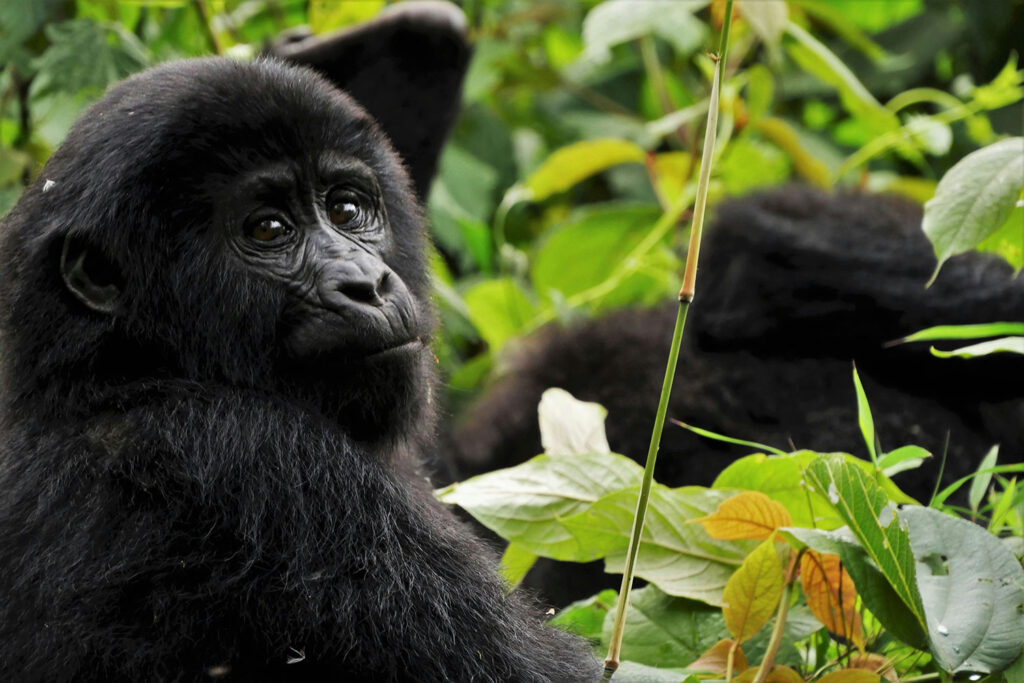
On gorillas specifically, Uganda and Rwanda aren’t offering the same experience twice. Mountain gorillas live across three protected areas that together form one connected ecosystem: Bwindi Impenetrable Forest and Mgahinga in Uganda, Volcanoes National Park in Rwanda, and Virunga National Park across the border in the Democratic Republic of Congo. Trekking a Bwindi family and a Volcanoes family on the same trip means two different forests, two different trekking styles, and two genuinely different groups of gorillas, not a repeat performance.
And the East Africa Tourist Visa, valid across Uganda, Rwanda and Kenya on a single application, removes what used to be the main administrative argument against combining countries.
Crossing the Border Between Uganda and Rwanda
Most combined safaris use one of two road crossings. Cyanika, between Kisoro and Musanze, is the direct route for anyone combining Bwindi or Mgahinga with Volcanoes National Park, and it’s the crossing built into both combined itineraries below. Katuna/Gatuna, further north on the main Kampala-Kigali highway, suits travelers routing through central Uganda rather than the southwest.
In practice, the crossing itself is straightforward: passport control, a visa check if one wasn’t arranged in advance, and in most cases a change of vehicle and driver-guide at the border, since Uganda and Rwanda license their safari guides separately. Luggage simply moves from one vehicle to the other, and the whole process typically takes well under an hour outside of unusually busy periods.
Combined Safari at a Glance
Typical Duration | 7 to 14 days, depending on how many parks and activities are combined |
Main Border Crossing | Cyanika (Kisoro, Uganda to Musanze, Rwanda) |
Visa Option | East Africa Tourist Visa, valid for Uganda, Rwanda and Kenya on one application |
Gorilla Permits | Separate permits required: Uganda Wildlife Authority (UWA) and Rwanda Development Board (RDB) |
Currency | Ugandan Shilling and Rwandan Franc; most park fees and permits are priced and paid in US Dollars |
Guides | Typically a different licensed driver-guide for each country’s leg |
Uganda vs Rwanda Gorilla Trekking, Side by Side
Travelers weighing a combined trip often want to know how the two countries actually differ, beyond the fact that both offer gorilla trekking. Here’s the practical comparison.
Feature | Uganda (Bwindi) | Rwanda (Volcanoes NP) |
Terrain | Dense rainforest, steep and often muddy trails | Volcanic foothills, generally gentler walking |
Typical Permit Price | Lower than Rwanda’s (reconfirm current pricing with UWA) | Higher than Uganda’s (reconfirm current pricing with RDB) |
Gateway Town | Kisoro or Buhoma | Musanze |
Access From Capital | 8 to 9 hour drive from Kampala, or a domestic flight to Kihihi | 2 to 3 hour drive from Kigali |
Trek Length | 45 minutes to 6+ hours to locate the family | Often shorter, 30 minutes to a few hours |
Extra Draw Nearby | Golden monkey trekking at Mgahinga | Golden monkey trekking in the same park |
What a Combined Uganda-Rwanda Safari Typically Includes
- Gorilla trekking permits for both Bwindi (or Mgahinga) in Uganda and Volcanoes National Park in Rwanda
- Private vehicle and driver-guide for the Uganda leg, with a separate licensed guide for the Rwanda leg
- The Cyanika or Katuna/Gatuna border crossing, including the vehicle and guide handover
- National park entrance fees in both countries
- Accommodation and meals as specified in the chosen package
- Optional add-ons: Queen Elizabeth wildlife viewing, Kigali city and genocide memorial visits, Lake Kivu or Lake Bunyonyi downtime
Popular Combined Routes to Choose From
Two ready-made itineraries on this site show how a combined trip typically comes together, and both can be shortened, extended or rebuilt around specific travel dates.
- 8-Day Double Gorilla Safari: Bwindi and Volcanoes National Park Back to Back, built for travelers who want both treks without adding wildlife parks or extra cities to the route
- 12-Day Uganda and Rwanda Grand Primate Safari, a fuller circuit that adds Queen Elizabeth’s game drives and Kigali’s culture around the two gorilla treks
Shorter 6-day and longer custom routes, including ones that fold in chimpanzee trekking or a Lake Kivu beach stop, can be built around the same Cyanika crossing on request.
Best Time for a Combined Uganda-Rwanda Safari
The dry seasons, June to September and December to February, suit both countries at once: trails in Bwindi and Volcanoes National Park are firmer, and the overland crossing itself is a more comfortable drive. Because this itinerary depends on two separate permit systems, booking three to six months ahead matters more here than for a single-country trip, particularly for fixed travel dates.

