
Gorilla Habituation Experience
Home » Gorilla Trekking » Gorilla Trekking in Uganda » Gorilla Habituation Experience
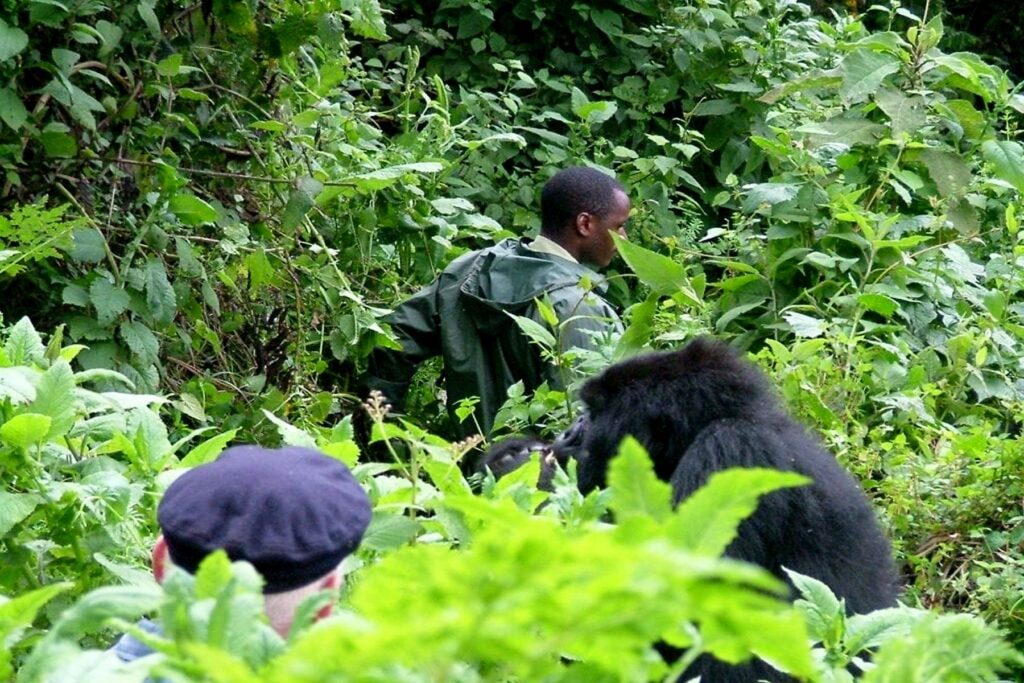
Gorilla Habituation Experience in Bwindi: The Complete Guide
Every standard gorilla trek in Uganda ends the same way: a strict, ranger-timed hour with the family, then the walk back out. The Gorilla Habituation Experience removes that clock. For up to four hours, a maximum of four visitors join researchers and trackers inside a gorilla family’s home range while it is still mid-process of becoming comfortable around people, watching habituation happen rather than visiting its finished result.
It is the single rarest permit in Uganda’s gorilla program, available on only one trail, in one sector, with four spots issued per day.
What is the Gorilla Habituation Experience?
Habituation is the slow, deliberate process rangers and researchers use to get a wild gorilla family used to the presence of humans, so that it can eventually be opened to regular tourist trekking. It typically takes two to three years of near-daily contact before a family is considered ready for standard visits.
The Gorilla Habituation Experience lets a small number of visitors join that process directly, walking in with the same team that’s doing the habituation work and spending real time observing a family that hasn’t yet settled into the calm, predictable routine a fully habituated group shows on a standard trek.
How it differs from standard gorilla trekking
- Time with the gorillas: up to 4 hours on the Habituation Experience, versus a fixed 1 hour on a standard trek
- Group size: capped at 4 visitors, roughly half the standard trekking group’s typical size
- Who you’re with: researchers and trackers actively working on habituation, not only a tourist guide
- Where it runs: Rushaga sector only, on specific families still in the habituation process
- Permit cost: priced above a standard gorilla trekking permit, reflecting the smaller group and longer access
- The gorillas themselves: less settled than a fully habituated family, so behavior can be less predictable moment to moment
Where the experience takes place
Rushaga, in Bwindi’s far south near the Rwanda border, is the only sector in Uganda offering this permit. Its families sit at various stages of the habituation process, and UWA designates which ones are open to the experience at any given time, which is part of why checking current availability directly with UWA matters more here than for a standard trek.
Lodges around Rushaga tend to be fewer and smaller than those near Buhoma, Bwindi’s most developed sector, which suits the experience’s already low-volume, unhurried character.
What happens on the day
Stage | What Happens |
Briefing | A ranger briefing at Rushaga park headquarters, earlier and more detailed than a standard trek’s, covering habituation protocol and expected behavior |
The trek in | Walking with trackers toward the family’s last known location, timing and terrain varying by where the group nested overnight |
Up to 4 hours with the family | Observing alongside the research team as the gorillas feed, rest and interact, with far more room to simply watch than a standard trek allows |
The walk back out | Returning to Rushaga headquarters, typically later in the day than a standard trek’s return |
Who the Habituation Experience is really for
It suits photographers and wildlife enthusiasts who’ve already done a standard trek and want meaningfully more time, travelers drawn to the research and conservation side of gorilla tourism rather than just the sighting itself, and anyone comfortable with a less polished, less predictable encounter in exchange for far more of it.
It is not the better starting point for a first-time visitor mainly chasing a reliable, well-paced introduction to gorilla trekking. A standard trek, with its shorter, more structured format and fully habituated families, generally suits that trip better.
Permit cost and how to book
The Habituation Experience permit is priced noticeably above a standard gorilla trekking permit, reflecting the smaller four-person cap and the extended time. Because only four permits are issued per day across the whole of Rushaga, booking months ahead matters even more here than for standard trekking, where daily capacity is considerably higher.
Permits are issued by UWA and are typically arranged through a registered tour operator as part of a broader itinerary, rather than booked as a stand-alone day trip.
Physical fitness and what to expect on the trail
Expect a longer, less predictable day than a standard trek. Because the family may not yet follow the settled feeding and resting patterns of a habituated group, the walk in can run longer, and four hours of observation, often standing or crouching in dense forest, adds up to a more physically demanding day overall. A reasonable level of fitness and comfort with uneven, muddy terrain matters more here than for most standard treks.
What to pack
- Sturdy, broken-in hiking boots with real ankle support
- Waterproof jacket and trousers, since Bwindi’s forest can turn wet with little warning
- Gardening-style gloves for pushing through nettles and undergrowth
- A daypack with water, snacks and energy for a longer day than a standard trek
- A reliable rain cover for cameras and lenses
Best time of year
The two dry seasons, June to September and December to February, generally mean firmer trails and a more manageable walk in, though habituation permits run year-round. Since so few permits are issued daily, availability on a specific date can matter more than the season itself, so an early booking often counts for more than ideal weather timing.