
7-Day Uganda Photographic Safari: Gorillas, Tree-Climbing Lions and Golden Monkeys
Overview
A standard safari moves on a schedule built around game drives and departure times. This one moves around light: dawn starts positioned for the tree-climbing lions’ best window, unhurried time in Bwindi’s low forest light, and a pace throughout built for photographers who’d rather wait twenty extra minutes for the shot than tick a box and move on.
The route stays entirely in Uganda’s southwest, linking three subjects rarely photographed together in one trip: mountain gorillas, golden monkeys and tree-climbing lions.
The full itinerary
The dry seasons, June to September and December to February, keep forest trails firmer for the gorilla and golden monkey treks and generally offer clearer skies for the Ishasha golden hour sessions. Overcast days in the wetter months can actually suit forest photography well, since diffuse light reduces harsh shadows under the canopy.
The drive from Kampala to Bwindi takes around eight to nine hours, timed where possible so the final approach into the hills happens in late-afternoon light rather than midday glare. A stop at the equator crossing in Kayabwe offers an easy, reliable frame along the way.
Briefing at the park headquarters runs around 7:30am. Bwindi’s forest interior is dim even at midday, so a fast prime lens or a wide aperture zoom, ideally f/2.8 or faster, matters more here than reach; most usable gorilla shots are taken within five to eight meters. The strict one-hour visit moves quickly, and shooting in continuous/burst mode with auto ISO capped around 6400 helps keep pace with the gorillas’ movement in low light.
Rather than rushing on immediately, this day stays in Bwindi for a guided birding and macro walk along the forest edge, useful both for practicing low-light forest technique before the golden monkey trek ahead and for the region’s own strong supporting cast: turacos, sunbirds and forest butterflies.
The transfer to Mgahinga Gorilla National Park, via Kisoro, takes around two to three hours. Golden monkeys move fast through dense bamboo, rewarding a lighter, more mobile setup and a higher shutter speed than the gorilla trek, since these primates rarely sit still for long.
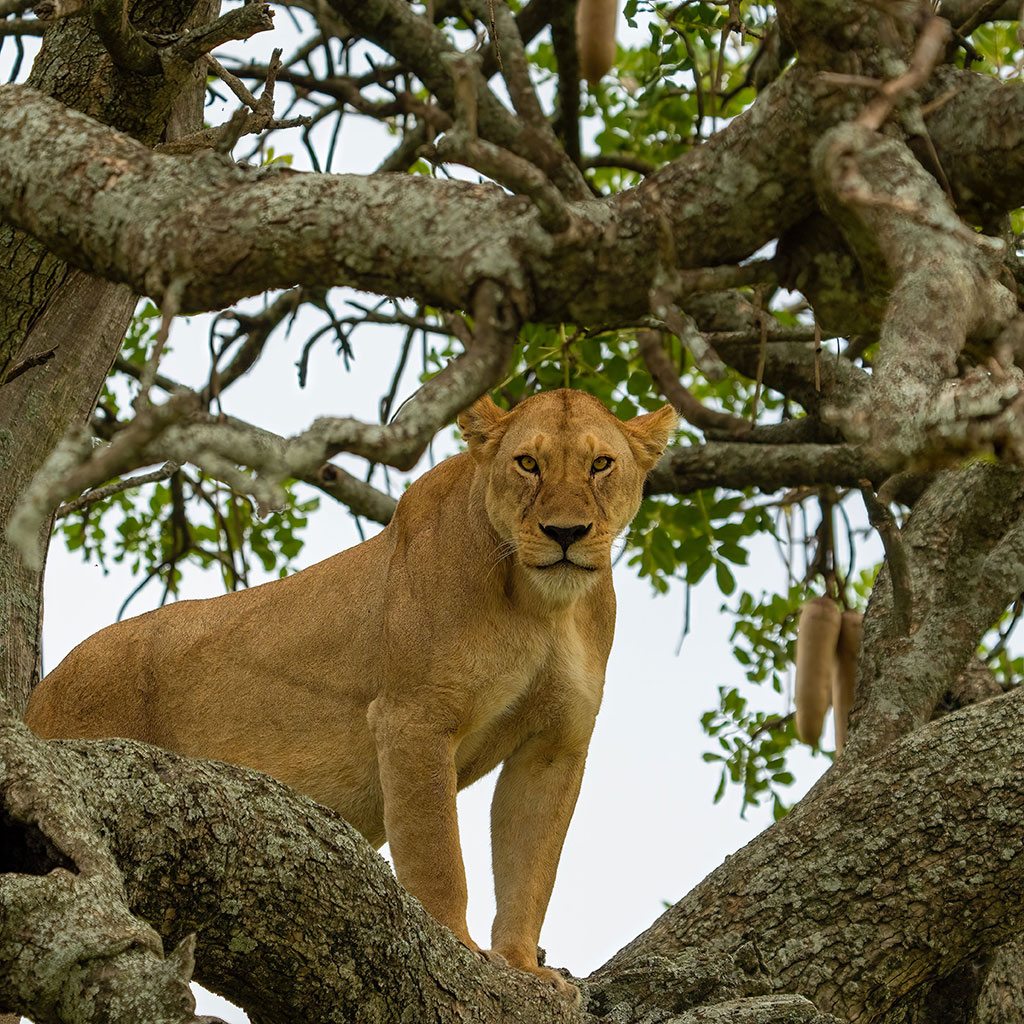
The transfer to Queen Elizabeth’s Ishasha sector positions the group for late-afternoon light, historically the most productive window for photographing the sector’s tree-climbing lions draped in its fig trees, when the low sun cuts through the canopy rather than flattening it from overhead.
A pre-dawn departure catches the Ishasha and Kasenyi plains in first light, the single best window for both lions and the atmospheric low mist that often sits over the grassland. Midday shifts to the Kazinga Channel launch cruise, useful for water-level shots of hippos and waterbirds that a vehicle can’t replicate, before a second late-afternoon session back in the golden hour.
The return drive retraces the route north and east, timed to connect with an evening international departure or an overnight before flying out.