
Birding
Home » Things To Do » Birding
Birding in Uganda and Rwanda: The Complete Guide for Bird Watchers
Put Uganda and Rwanda side by side on a map and they barely register, two small, landlocked countries tucked against the Albertine Rift. Put their bird checklists side by side instead, and the picture flips: between them, these two countries hold a share of Africa’s bird diversity that nations many times their size can’t match.
Why Uganda and Rwanda belong on every birder’s list
Most of what makes these two countries exceptional for birding comes down to how many habitats sit within such a short drive of each other. Papyrus wetland, Congo basin lowland forest, open savanna and Albertine Rift montane forest all exist within the same compact region, which is unusual: in many other African birding destinations, covering that range of habitats means covering thousands of kilometers.
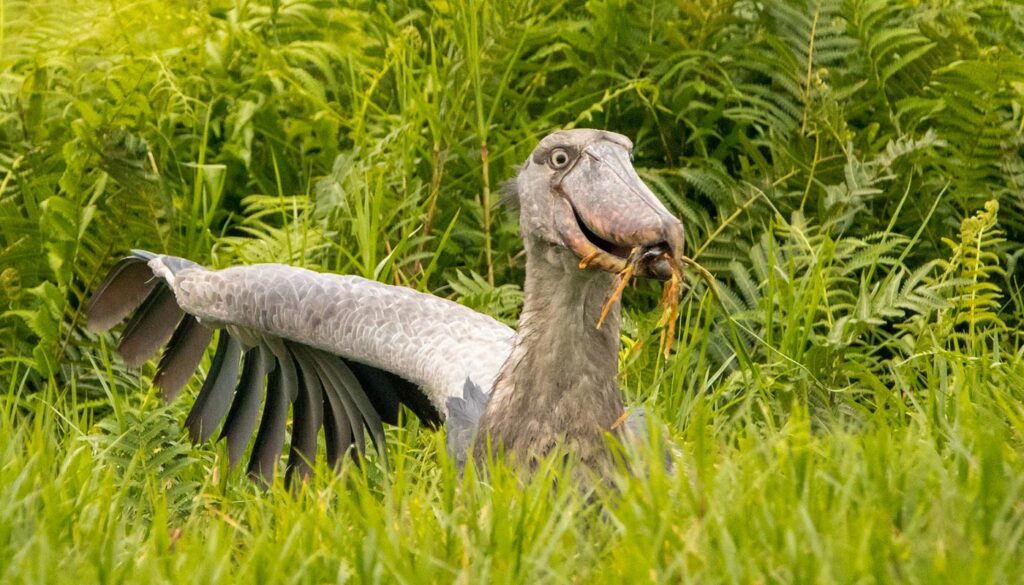
That compression is the real draw. A birder can go from a papyrus swamp hunting for the shoebill to a montane forest trail lined with endemics found almost nowhere else on Earth, without the multi-day transfers larger countries demand.
Top birding destinations
Mabamba Swamp | Uganda’s most reliable shoebill site, reached by dugout canoe through papyrus channels on the shores of Lake Victoria |
Bwindi (Ruhija / Mubwindi Swamp) | The best single trail in the region for Albertine Rift endemics, including the African green broadbill |
Semuliki National Park | Uganda’s outpost of the Congo basin, holding Guinea-Congo biome species found almost nowhere else in East Africa |
Queen Elizabeth / Kazinga Channel | Dense waterbird activity, raptors and savanna species, with a launch cruise doubling as a birding outing |
Kibale / Bigodi Wetland | Forest-edge habitat known for the great blue turaco and a strong supporting primate cast |
Lake Mburo National Park | Dry acacia savanna specials, including papyrus gonolek, within easy reach of Kampala |
Murchison Falls National Park | Shoebill sightings along the Victoria Nile delta, alongside savanna raptors and the falls themselves |
Nyungwe Forest (Rwanda) | A canopy walkway through montane forest holding a strong concentration of Albertine Rift endemics |
Volcanoes National Park (Rwanda) | Montane forest species alongside gorilla and golden monkey trekking in the Virunga foothills |
Species worth traveling for
A handful of species anchor most serious birding trips to this region, and planning around them shapes the whole route.
- Shoebill: a prehistoric-looking stork relative found in papyrus swamps, most reliably at Mabamba Swamp and the Victoria Nile delta in Murchison Falls
- African green broadbill: an Albertine Rift endemic found almost exclusively along Bwindi’s Mubwindi Swamp trail
- Great blue turaco: a large, strikingly colored forest turaco common around Kibale and Bigodi Wetland
- Grauer’s rush warbler: another Albertine Rift endemic, restricted to a handful of swamp-edge sites including Bwindi
- African skimmer and pink-backed pelican: regular sightings along the Kazinga Channel’s dense waterbird activity
- Rwenzori turaco: found in the montane forests of both Bwindi and Rwanda’s Nyungwe and Volcanoes National Parks
When to go
The dry seasons, June to September and December to February, keep forest trails at sites like Semuliki and Mubwindi Swamp easier underfoot, which matters more here than on an open savanna game drive. These months also tend to have more predictable travel conditions overall.
November through April brings Palearctic migrants through the region’s wetlands, which can meaningfully lift species counts at Mabamba Swamp and the Kazinga Channel for birders specifically chasing a longer list rather than easier walking.
Planning your birding trip
A specialist birding guide isn’t strictly necessary everywhere, but it makes a measurable difference at sites like Mabamba Swamp and the Mubwindi Swamp trail, where call recognition and local knowledge of a species’ current territory can be the difference between a sighting and a long walk back empty-handed.
Pack a solid pair of 8×42 binoculars, a field guide or a reliable app with offline maps, and clothing in neutral, non-reflective colors. Early starts matter more than almost anything else: bird activity peaks in the first two to three hours after dawn and tails off sharply once the sun is high.
Suggested birding itineraries
For travelers who want a full route built around these sites rather than planning one from scratch, two ready-made itineraries cover most of what’s on this page.
- 8-Day Uganda Birder’s Trail: Shoebill, Albertine Rift Endemics and Bwindi — a four-habitat route from Mabamba Swamp through Semuliki and Kibale to Bwindi’s Mubwindi Swamp trail
- 5-Day Mabamba Swamp Shoebill and Queen Elizabeth Birding Circuit — a shorter trip pairing the shoebill with Queen Elizabeth’s savanna and wetland birding