
Nyungwe National Park
Nyungwe National Park, Rwanda, Africa’s Ancient Montane Rainforest
Long before the first tea bushes were planted on the hills of southwestern Rwanda, and long before there was a country called Rwanda at all, Nyungwe was already old. Scientists believe this forest survived the last Ice Age when much of Africa’s woodland retreated, giving its plants and animals thousands of years of uninterrupted time to evolve. The result is a mist-wrapped world of giant tree ferns, hanging lichens, orchids, waterfalls and thirteen species of primates, set across steep ridges that rise close to 3,000 metres above sea level.
Today Nyungwe National Park is Rwanda’s largest protected mountain forest and, since September 2023, a UNESCO World Heritage Site. It is the place to go in Rwanda for chimpanzee trekking, the famous Nyungwe canopy walk, serious birding and some of the most rewarding rainforest hiking in East Africa. For travellers coming from Uganda, Nyungwe is also the perfect partner to a gorilla trek in Bwindi or Volcanoes National Park, turning a single primate encounter into a complete great-ape journey across two countries.
History and Background of Nyungwe Forest
Nyungwe is a relic of a much larger forest belt that once stretched along the mountains of the Albertine Rift. Because it stood on high, well-watered ground, it is thought to have acted as a refuge during the dry, cold periods of the Pleistocene, when lowland forests shrank. Species sheltered here and later spread out again, which helps explain why Nyungwe has so many plants and animals found nowhere outside this mountain chain.
The forest was first given official protection as a reserve in 1933, during the colonial period. Over the following decades it faced heavy pressure from farming, wood cutting, mining for gold, hunting and fire, and some edges of the forest were lost. Conservation research gained momentum in the late twentieth century, with studies of its primates, birds and plants revealing just how important Nyungwe was. In 2004 the reserve was upgraded to a national park, giving it the strongest protection available under Rwandan law.
Geography, Landscape and Climate
Nyungwe covers steep, folded mountains on the edge of the Albertine Rift, sloping west toward Lake Kivu and the Democratic Republic of Congo. Deep valleys, sharp ridges and fast streams mean that every turn of the road reveals a new view across an unbroken green sea of trees. The main tarmac road between Huye and Rusizi (Cyangugu) runs straight through the park for about 50 km, so even the drive is a scenic experience, often with monkeys sitting at the roadside.
The park straddles the watershed between Africa’s two largest river basins. Streams on the eastern slopes feed the Rukarara and Mwogo rivers, which flow into the Nyabarongo and eventually the Kagera River and Lake Victoria. Research expeditions have pointed to the Rukarara headwaters in Nyungwe as the most distant source of the Nile. Streams on the western slopes run to Lake Kivu and onward to the Congo River. Nyungwe’s forests also supply a large share of Rwanda’s fresh water, which is one of the strongest reasons for its protection.
Nyungwe is one of the wettest places in Rwanda, receiving roughly 2,000 mm of rain a year. Daytime temperatures generally range from about 10°C to 20°C, and mornings can be cold, especially at higher points such as Uwinka. Mist is common and adds to the magical, cloud-forest atmosphere. Expect at least some rain at any time of year and pack accordingly.
Top Things to Do in Nyungwe National Park
Chimpanzee Trekking.
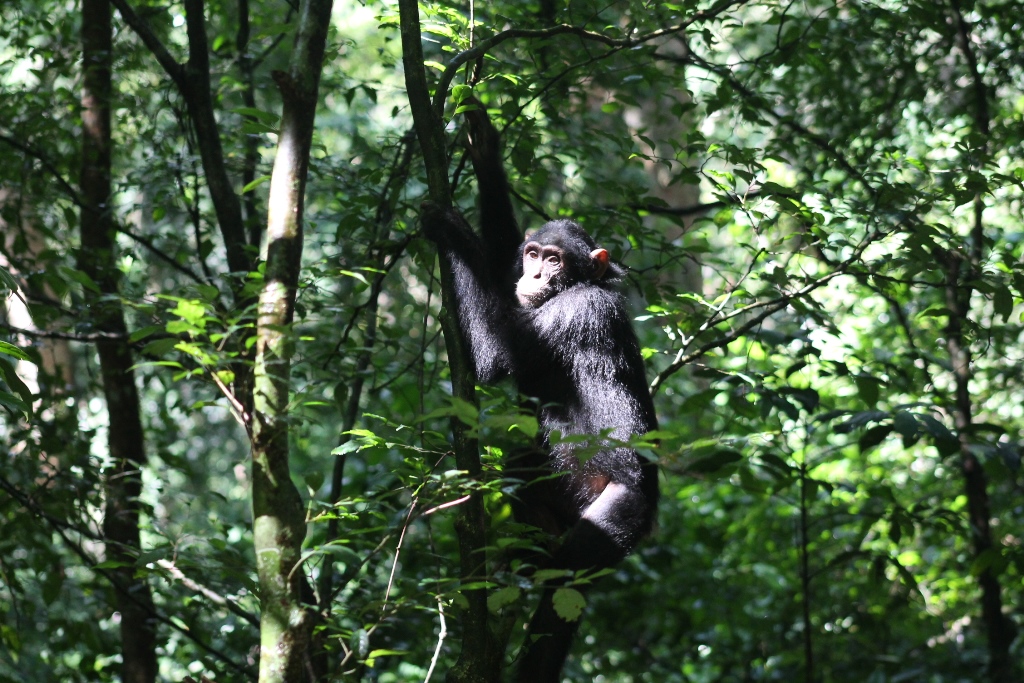
Chimpanzee tracking is Nyungwe’s headline activity and the reason most travellers come. Treks begin very early, usually with a briefing around 5:00 to 5:30 am, because chimpanzees are most active and vocal at dawn as they leave their nests and travel to feeding trees.The main habituated chimpanzee community lives in the forest near Uwinka and the Gisakura side of the park, while another habituated group lives in Cyamudongo Forest.
Nyungwe Canopy Walkway
The canopy walkway is Nyungwe’s most iconic experience and one of the very few in Africa. The suspension bridge stretches about 200 metres across a deep forested valley near the Uwinka Visitor Centre, reaching around 50 to 70 metres above the forest floor at its highest point. Reaching the walkway involves a guided hike on the Igishigishigi Trail, a gentle trail of about 2 km that passes giant tree ferns and great birding.
Tea Plantation Tours
The bright green tea estates at Gisakura and Kitabi on the park’s edges are some of the most beautiful agricultural landscapes in Africa. A tea experience lets you walk among the bushes, learn how leaves are plucked by hand, and visit a processing factory to follow the journey from leaf to cup. Rwandan tea is known for its quality, and buying it locally supports community livelihoods.
Best Time to Visit the Park
For first-time visitors who want comfortable hiking, June to September and December to February are ideal. Birders often prefer the wetter months for breeding plumage and active song. Whatever the season, waterproof gear is essential.
June – September, Drier trails, easier hiking, and the canopy walk at its most comfortable; peak season, so book early
December – February, Good weather with some showers; excellent all-round time to visit.
March– May, Heavy rain and muddy trails, but lush scenery, fewer visitors, and chimps may stay lower in fruiting trees.
October – November, Mixed weather; rewarding for birders as migrants arrive and many species breed.
How to Get to Nyungwe National Park
From Kigali by Road
Nyungwe’s eastern boundary is roughly 180–225 km from Kigali depending on which entrance you use, a drive of about 5 to 6 hours on good tarmac roads. The route heads south through Muhanga and Nyanza to Huye, then west through rolling hills and the Kitabi tea estates into the park itself. Breaking the journey with the museums at Nyanza or Huye makes the drive part of the adventure.
By Domestic Flight
RwandAir operates flights from Kigali International Airport to Kamembe Airport in Rusizi, near the southern tip of Lake Kivu. The flight takes about 30 to 45 minutes, and from Kamembe it is around 1 to 1.5 hours by road to Gisakura. This option suits travellers with limited time. Schedules change, so we confirm flight days when planning.
People and Culture Around Nyungwe
Nyungwe is surrounded by some of Rwanda’s most densely populated farming communities. Life here revolves around tea, potatoes, beans, bananas and livestock, and the forest has long shaped the culture of the people who live beside it.
Traditional Forest Knowledge
For generations, local communities gathered medicinal plants, honey, wild foods and building materials from the forest. Elders hold detailed knowledge of plants used to treat fevers, wounds and stomach problems. Guided walks often include stories of these traditional uses, and community tours sometimes include demonstrations by herbalists. Some families once practised hunting and small-scale gold mining inside the forest; many former hunters and miners now work in conservation, as porters, rangers or guides, a powerful example of how tourism changes lives.
Banda Village and Community Tourism
Banda, a village close to the park, is known for its community tourism project, where visitors can learn about traditional homestead life, food preparation, banana beer brewing, local medicine and dance. Profits support community development and help build positive relationships between the park and its neighbours. Rwanda’s tourism revenue-sharing scheme also returns a portion of park income to surrounding communities for schools, health centres and water projects.
Music, Dance and Crafts
Rwandan culture comes alive in the drumming (ingoma), the energetic Intore dance traditionally performed by warriors, and the graceful movements of women’s dances, which imitate the long-horned Inyambo cattle. Around Nyungwe, community groups perform for visitors, and evening performances can sometimes be arranged at lodges. Local crafts include woven baskets with intricate geometric patterns (including the famous peace baskets), pottery, and banana-leaf art.
Frequently Asked Questions about Nyungwe National Park
Nyungwe is in southwestern Rwanda, bordering Burundi’s Kibira National Park to the south and stretching west toward Lake Kivu. It lies about 5 to 6 hours’ drive from Kigali.
Yes. The walkway is built with steel cables and high safety netting, and walks are guided. It is suitable for most people, including those mildly nervous about heights.
The minimum age is generally 15 years; please confirm when booking. Younger children can enjoy colobus tracking, shorter hikes, the canopy walk (subject to park rules) and tea tours.
Contact Trek Gorilla Uganda with your travel dates, group size and interests. We will design a tailor-made itinerary, confirm permits and lodges, and support you from enquiry to departure.
Contact Trek Gorilla Uganda with your travel dates, group size and interests. We will design a tailor-made itinerary, confirm permits and lodges, and support you from enquiry to departure.