
Rules and Etiquette
Home » Gorilla Trekking » Gorilla Trekking Guide » Rules and Etiquette
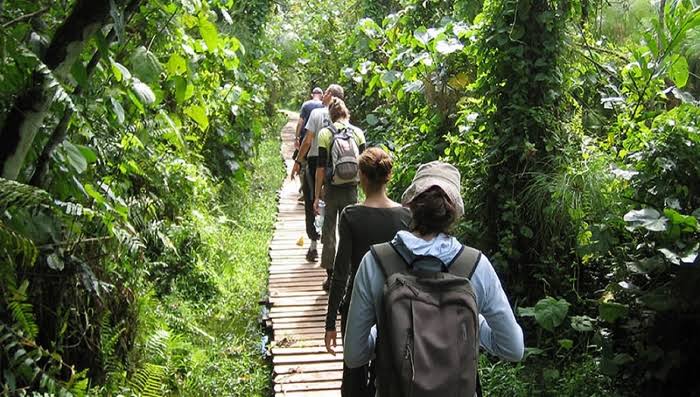
Gorilla Trekking Rules and Etiquette: The Complete Visitor Guide
Gorilla trekking rules exist because of a fact most first-time visitors never stop to consider: a cold that barely slows you down could kill a mountain gorilla. Humans and gorillas share roughly 98 percent of their DNA, which means our illnesses transfer to them with alarming ease, and a population still numbering only around a thousand individuals cannot absorb that risk the way a human community can.
Why the rules exist
Mountain gorillas were brought back from the edge of extinction partly through habituation, the slow, patient process of getting a wild family comfortable enough with human presence to be observed without fleeing or attacking. That comfort is fragile. A visitor who gets too close, moves suddenly or raises their voice can undo months of a habituation team’s work and leave a family more wary of the very protection program keeping it alive.
Disease transmission is the more immediate concern on any single trekking day. Respiratory illnesses in particular move easily between humans and great apes, and a gorilla’s immune system has had no exposure to the strains constantly circulating in human populations. The distance rule, the mask guidance and the illness policy below all exist to interrupt that transmission route before it starts.
Before you go: health and age requirements
The minimum age is 15, strictly enforced
Both Uganda’s Wildlife Authority and Rwanda’s Development Board set the minimum trekking age at 15, with no exceptions made for younger children even when accompanied by a parent. The reasoning combines the physical demands of the trek itself with the difficulty of guaranteeing a young child will stay quiet and controlled in close proximity to a wild animal.
Feeling unwell? Stay behind
If you wake up on trekking day with a cough, a cold, flu symptoms, diarrhoea or any other communicable illness, you’re asked to sit this one out. Permits can usually be transferred to another day or, in some cases, partially refunded on medical grounds, but this is a rule rangers take seriously and can enforce at the briefing stage, before you ever reach the forest.
A basic level of fitness helps, but isn’t required
Trails range from a gentle 45-minute walk to a demanding six- or seven-hour climb through steep, often muddy terrain, depending entirely on where the gorilla family nested the night before. Porters are available at every trailhead for travelers who want extra support, and hiring one is both a practical choice and a direct way to support the local economy around the park.
During the encounter: what to do and what to avoid
Keep 7 metres of distance at all times
Seven metres, roughly 21 feet, is the standard minimum distance between visitors and gorillas, measured not just at first sighting but maintained throughout the full visit. Gorillas themselves don’t always respect this boundary, since a curious juvenile or a silverback moving through the group may close the gap on their own, in which case your guide will quietly direct you to step back rather than hold your ground for a better photo.
No flash photography
Camera flashes can startle gorillas and, in a worst case, provoke a defensive reaction from a protective silverback. Shooting in natural light, even the low light common under Bwindi’s canopy, is the rule everywhere on the continent where gorillas are trekked, so it’s worth practicing your low-light settings before you go rather than discovering the limitation mid-visit.
Speak softly, move slowly
Loud voices, sudden movements and pointing directly at a gorilla all register as mild threats in gorilla body language. Guides generally communicate in near-whispers once the family is found, and following that lead, rather than narrating the experience to your trekking companions at normal volume, keeps the visit calm for everyone, gorillas included.
No eating, drinking or smoking near the gorillas
Food and drink stay in your daypack once you’re within viewing distance, both to avoid attracting the gorillas’ attention to your bag and to reduce any risk of contamination. Smoking is prohibited throughout the park for the same reason it’s prohibited near any protected forest habitat.
If a gorilla approaches or charges
A mock charge, a short, loud rush that stops well short of contact, happens occasionally and is more a display of dominance than an attack. The instinctive human response, to run, is exactly the wrong one, since it can trigger a chase reflex. The correct response is to stay still, crouch down slowly to appear smaller and less threatening, avoid direct eye contact, and wait for your guide’s instruction.
Trackers and ranger guides are trained specifically for these moments and are rarely more than a few steps away during the viewing hour. Trusting their judgment in real time, rather than reacting on instinct, is the single most important piece of etiquette on this entire list.
Health and hygiene protocols
Masks are often required at close range
Since the COVID-19 pandemic highlighted just how easily respiratory illness moves between humans and great apes, many parks request or require a surgical-style mask once visitors are within a few metres of a gorilla family, even for travelers who are otherwise symptom-free. Carrying two or three disposable masks in your daypack is a simple, low-cost precaution worth taking regardless of the day’s specific requirement.
Wash or sanitize your hands before the trek
A quick hand sanitizing station is standard at most trailheads, and using it before you set off is a small habit with an outsized benefit, given how directly this entire rule set is built around limiting disease transmission.
Trail and environmental conduct
Nature calls on the trail
If you need to relieve yourself during the trek, your guide will direct you well away from the trail and, in most cases, ask that any waste be buried rather than left exposed. It’s an unglamorous detail, but it matters in a forest ecosystem this sensitive, and guides are used to handling the request discreetly.
Carry out everything you carry in
Wrappers, tissues and any other litter go back into your daypack and out of the park with you. Bwindi and Volcanoes National Park both operate on a strict leave-no-trace basis, and a dropped wrapper is more than a litter problem in a habitat this carefully protected.
Stay on the path your guide sets
Trackers cut a path through dense vegetation specifically to minimize damage to the forest and to approach the gorilla family from an angle unlikely to alarm them. Wandering off that path, even a few steps for a better camera angle, undoes both of those considerations at once.
What to wear and what to carry
- Neutral, muted colors (khaki, olive, brown) rather than bright or white clothing
- Long sleeves and long trousers, ideally tucked into socks or gaiters against biting forest ants
- Sturdy, broken-in hiking boots with good ankle support
- Gardening-style gloves for pushing through thorny or nettled vegetation
- A light rain jacket, since Bwindi’s weather shifts quickly regardless of season
- A daypack with water, snacks, a basic first-aid kit and two or three disposable masks
- A walking stick or trekking pole, either brought from home or rented cheaply at the trailhead
Tipping etiquette: guides, trackers and porters
Tipping isn’t mandatory, but it is firmly customary, and the people who make a gorilla trek possible, the lead guide, the trackers who locate the family before you arrive, and any porter you’ve hired, rely on it as a meaningful part of their income. There’s no official fixed rate, but a tip reflecting the effort involved and your own means is the general standard, handed over directly and privately at the end of the trek rather than pooled anonymously.
Porters in particular are often local community members for whom trekking-season work makes a real difference, and hiring one, even if you don’t feel you need the physical help, is one of the more direct ways a single visitor’s spending supports the community living alongside the park.
What happens when the rules are broken
Rangers have the authority to end a visit early if a visitor’s behavior puts the gorillas or the group at risk, whether that’s repeatedly closing the distance for a photo, raising their voice, or ignoring an instruction during a charge. It’s a rare outcome, since most rule-breaking is unintentional and corrected with a quiet word, but it underscores that the ranger’s judgment on the day takes priority over any individual visitor’s itinerary.
Permits themselves are non-transferable to another person and non-refundable for a last-minute decision not to follow the rules, which is one more reason the briefing at the start of the day is worth genuinely listening to rather than treating as a formality.