
Gorilla Trekking Guide
Home » Gorilla Trekking » Gorilla Trekking Guide
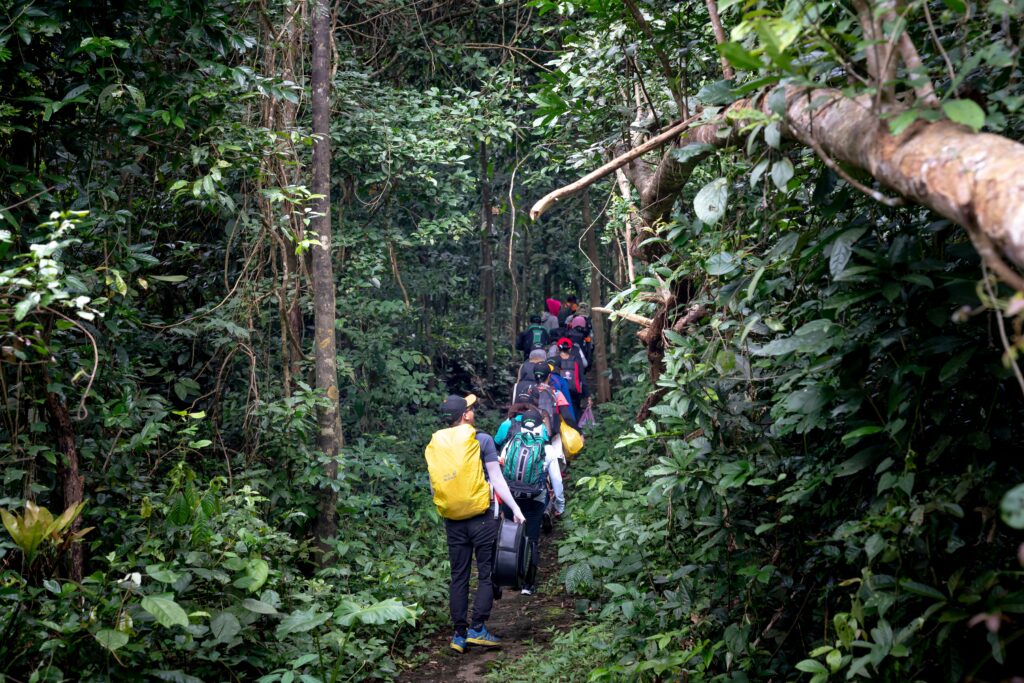
Gorilla Trekking in Uganda & Rwanda: The Complete Guide
Somewhere around your third hour on a Bwindi trail, calves burning, shirt soaked through, your guide will suddenly stop, lower his voice to barely a whisper, and point into a wall of green that looks, to you, like every other wall of green you’ve been climbing past all morning. Then a branch moves. Then you see him: a 180-kilogram silverback, close enough to hear him breathe, utterly uninterested in the fact that you exist.
That moment is what every gorilla trekking guide, blog post and brochure is trying to describe, and most of them undersell it. This page skips the sales pitch and gets into the part people actually search for: what it costs, how hard it is, which park to pick, and what you genuinely need to know before you book.
What gorilla trekking actually involves
Gorilla trekking means hiking into protected forest, with an armed ranger and a tracking team, to spend a strictly timed hour with a habituated family of mountain gorillas. ‘Habituated’ is the key word: these are wild gorillas that have spent two to three years gradually getting used to quiet human observation, not animals in an enclosure and not animals that perform for visitors.
Trackers set out before dawn from the spot the family was last seen the previous evening, following nest sites, feeding trails and dung to relocate them. Your group joins the search once they’re close, and the walk to reach the gorillas, not the hour with them, is what makes the experience unpredictable: it can take 45 minutes or it can take most of a day.
Uganda or Rwanda: where should you trek?
Both countries protect mountain gorillas in the same wider Virunga and Bwindi ecosystem, and both deliver the same core experience. The honest differences are cost, terrain and how the rest of your trip shapes up around the trek.
Factor | Uganda (Bwindi) | Rwanda (Volcanoes NP) |
Standard permit price | Around $800 per person | Around $1,500 per person |
Terrain | Steep, dense rainforest, often muddy | Steep volcanic slopes, generally shorter approach |
Distance from capital | 8–9 hours by road from Kampala, or a short flight | 2–3 hours by road from Kigali |
Habituated families | Spread across 4 sectors, more total families | Fewer families, higher daily permit price keeps groups smaller |
Good to pair with | Queen Elizabeth NP, Kibale chimps, Lake Bunyonyi | Lake Kivu, golden monkey trekking, Kigali city |
Neither country is the ‘wrong’ choice. Budget-conscious travelers and those already building a Uganda wildlife itinerary generally lean toward Bwindi. Travelers short on time, or pairing the trek with a Rwanda-based trip, often prefer Volcanoes National Park’s shorter approach from Kigali.
Gorilla trekking permits: cost, booking and availability
The permit is the single biggest line item in any gorilla trekking budget, and it’s non-negotiable: no permit, no trek, regardless of how much else you’re willing to pay. In Uganda, permits are issued by the Uganda Wildlife Authority (UWA); in Rwanda, by the Rwanda Development Board (RDB).
- Uganda: standard permit around $800 per person, covering one hour with a gorilla family and all park entrance fees for that day
- Rwanda: standard permit around $1,500 per person, with an optional, higher-priced photographic permit offering a smaller group and extended time
- Only a fixed number of permits are issued per day, split across the available habituated families, so dates fill up, especially June to September and December to February
- Book 3 to 6 months ahead for peak season; shoulder months sometimes have availability just weeks out
- Permits are generally non-refundable but can often be rescheduled with enough notice if plans change; confirm the exact policy when booking
Choosing your trekking sector
Where you trek determines your drive time, your lodge options and, to some extent, the terrain you’ll face. Bwindi Impenetrable National Park is split into four trekking sectors, each with its own park headquarters and its own set of gorilla families.
- Buhoma: the original, most established sector, generally gentler terrain and the widest lodge selection
- Ruhija: higher altitude, cooler, and close to the Mubwindi Swamp birding trail if you’re combining interests
- Rushaga: the most families of any sector, and the only sector offering the Gorilla Habituation Experience
- Nkuringo: dramatic scenery, but consistently the most physically demanding sector to trek
Rwanda’s Volcanoes National Park works differently: all trekking is based from a single headquarters at Kinigi, with families assigned on the morning of your trek rather than tied to a separate sector. Uganda’s Mgahinga Gorilla National Park, in the same Virunga range as Volcanoes NP, offers a smaller, quieter alternative when its one habituated family is being tracked there rather than across the border.
Best time of year to go
Gorilla trekking runs year-round in both countries; there’s no closed season. The difference between the dry and wet months comes down to trail conditions, not whether gorillas are available.
Season | Months | What to expect |
Dry season (peak) | June–September, December–February | Firmer trails, easier walking, highest permit demand |
Wet season (shoulder/low) | March–May, October–November | Muddier, slower-going trails, better permit availability, lush scenery |
Rain is genuinely possible in any month in this part of the world; Bwindi’s name translates roughly to ‘impenetrable,’ and the forest earns it. Packing for mud and moisture matters regardless of when you book.
How fit do you need to be?
Fitter than a game drive, less extreme than most people assume. There’s no minimum fitness test and no age-based physical exam, but the walk itself can genuinely run from a gentle 45 minutes to a demanding six or seven hours of steep, uneven, sometimes muddy terrain at altitude.
A few honest points worth knowing before you commit: rangers do their best to match physically harder treks to fitter, younger groups when they can, though this isn’t guaranteed. Hired porters, generally $15 to $20 for the day, carry your bag and, just as importantly, offer a steadying hand on steep or slippery sections. For travelers with limited mobility, both Uganda and Rwanda offer a sedan-chair style stretcher carried by a team of porters, bookable in advance for an additional fee.
What actually happens on trekking day
- 6:30–7:00am: wake-up and early breakfast at your lodge
- 7:30am: briefing at park headquarters, groups of up to 8 trekkers assigned to a specific gorilla family
- 8:00am onward: the hike begins, led by a ranger guide with armed escorts and trackers already in the forest ahead
- Family located: anywhere from 45 minutes to several hours after setting out
- The visit: a strictly enforced 60 minutes with the gorillas, timed from the moment the full group arrives
- The walk back: often faster than the walk in, since the route back tends to be more direct
- Certificate ceremony: most lodges or park offices mark the day with a printed trekking certificate
Gorilla trekking rules and etiquette
These rules exist because mountain gorillas share roughly 98% of human DNA, which means human illnesses, a common cold included, can spread to them and prove far more dangerous to a gorilla than to a person. The guidelines are strict for good reason.
- Stay at least 7 meters (about 21 feet) from the gorillas at all times, though they don’t always respect that distance themselves
- No flash photography, and keep your voice low throughout the visit
- Anyone with a cold, flu or other contagious illness will be asked not to trek, and a doctor may assess trekkers on arrival
- No eating or drinking once you’re near the gorilla family, and no littering anywhere on the trail
- If a gorilla charges, which is rare and almost always a bluff, stay still, avoid eye contact and follow your guide’s instructions
- Groups are capped at 8 trekkers per gorilla family per day, to limit stress on the animals
The Gorilla Habituation Experience: is it worth it?
Offered only in Bwindi’s Rushaga sector, the Gorilla Habituation Experience trades the standard one-hour visit for up to four hours with a family that’s still partway through the habituation process, alongside researchers and trackers actively doing that work. Only 4 permits are issued per day, at a higher price than the standard trek.
It suits travelers who’ve already done a standard trek and want to go deeper, or anyone prioritizing time and a smaller group over the lower cost of the regular permit. It isn’t a ‘better’ version of a first gorilla trek so much as a different one, closer to watching conservation work in progress than a polished wildlife encounter.
What to pack for gorilla trekking
- Sturdy, broken-in hiking boots with ankle support, ideally waterproof
- Gardening gloves or similar, for gripping stinging nettles and thorny undergrowth on the way up
- Long trousers and a long-sleeved shirt, tucked in, to guard against nettles and biting ants
- A lightweight rain jacket, even in the dry season
- Gaiters, if you have them, to keep mud and ants out of your boots
- A daypack with 2 liters of water, snacks and a dry bag for your camera
- A camera with a fast lens, since Bwindi’s forest interior is dim even at midday
- Cash in small denominations for your porter and tipping
Age, health and other restrictions
- The minimum age for gorilla trekking is 15 in both Uganda and Rwanda, with no official upper age limit
- Anyone showing signs of a contagious illness on the morning of the trek may be refused entry and, depending on the operator, offered a rescheduled date
- Pregnant travelers are not explicitly barred, but the physical demands and health guidelines around close animal contact are worth discussing with a doctor beforehand
- A valid passport is required at park headquarters on trekking day; permits are non-transferable and tied to the name on file
Budgeting beyond the permit
The permit is the headline cost, but it’s rarely the only one. A realistic day’s budget, beyond the permit itself, includes a porter ($15–20), a tip for your ranger guide and trackers (customary, not compulsory, often $10–20 per person), and the accommodation and transport that bring you to the park in the first place, which can range from simple guesthouses to premium forest lodges depending on the sector and season.