
7-Day Uganda Big Five Safari: Murchison Falls to Queen Elizabeth
Overview
Uganda lost its wild rhinos to poaching decades ago, which means no single national park here can complete the Big Five on its own. This itinerary solves that by stringing together the three places that can: a rhino tracking stop at Ziwa Sanctuary, the lion and elephant country of Murchison Falls, and the lion, buffalo and leopard territory around Queen Elizabeth.
Seven days is enough time to do all three properly, with two full game-viewing parks and a Nile launch cruise built in rather than squeezed into transit days.
The full itinerary
The dry seasons, December to February and June to September, keep game drive tracks passable and concentrate wildlife around permanent water sources like the Kazinga Channel, making sightings more predictable. The wetter months bring lush scenery and fewer vehicles at each sighting, but tracks in both parks can be slower going after heavy rain.
The drive north from Kampala breaks naturally at Ziwa Rhino Sanctuary, roughly three hours out, where guided walks bring you within a safe, ranger-controlled distance of southern white rhinos on foot. It’s the only place left in Uganda to see this species outside a zoo, and it’s what makes a genuine Big Five itinerary possible here at all.
From Ziwa, the road continues another three to four hours to Murchison Falls National Park, with the Nile’s Victoria stretch and its resident elephant herds often visible before you’ve even checked in.
An early game drive across the park’s northern delta grasslands is the best window for lions, and Murchison’s savanna also holds strong numbers of elephant, buffalo and Rothschild’s giraffe. The afternoon launch cruise heads upriver toward the base of the falls itself, past dense hippo pods and some of the largest Nile crocodiles left in East Africa.
Where the entire Nile forces itself through a gap barely seven meters wide, the top of the falls is worth the short hike for the sheer force of the water alone. From there, the route turns south, breaking up the long transfer to Queen Elizabeth with stops at the Rwenzori foothills and the region’s volcanic crater lakes.
Queen Elizabeth’s Kasenyi plains, close to the park’s northern gate, are the most reliable spot for an afternoon lion sighting after a long travel day, with resident prides often found resting in the open grassland or along the track edges.
A two-hour launch cruise along the Kazinga Channel, the natural waterway linking Lakes Edward and George, typically produces the single highest concentration of wildlife on the whole trip: hippos by the hundred, buffalo herds, elephants coming down to drink, and a long list of waterbirds along the banks.
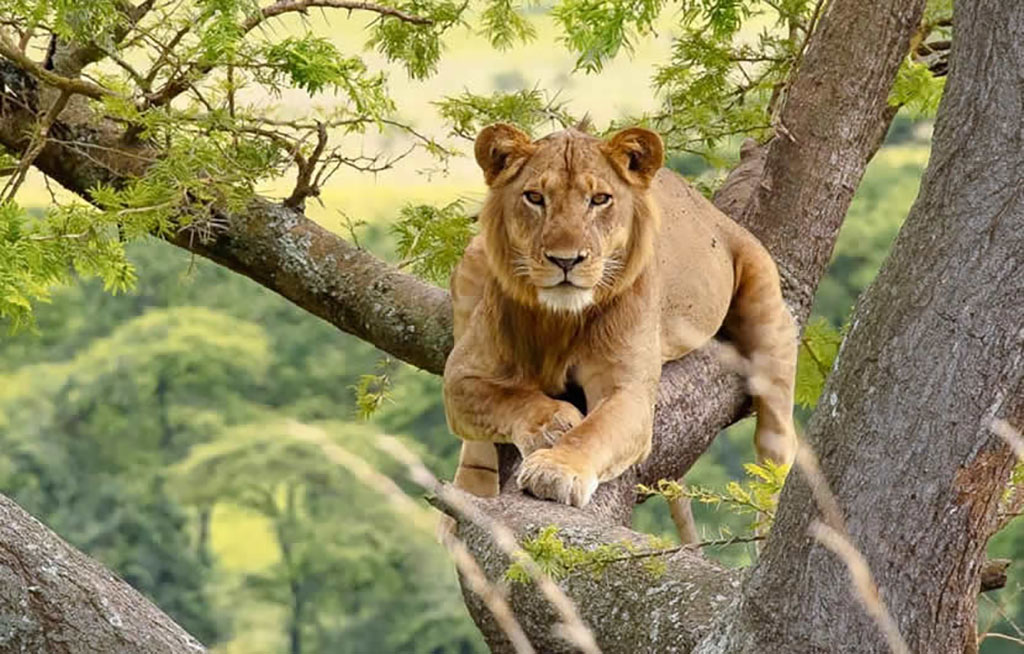
The Ishasha sector, a two-hour drive south of the main park, holds one of only two lion populations in Africa known to regularly climb trees, most often found draped in the branches of the sector’s fig trees during the heat of the day. It’s a full day dedicated to one specific, unusual behavior rather than a general game drive.
The drive back retraces the route north out of Ishasha and on to Kampala or Entebbe, timed to connect with an evening international departure or an overnight before flying out.